
Federal & Defense
CMMC
DoD contractors handling FCI and CUI.
The Cybersecurity Maturity Model Certification program applies cybersecurity requirements to organizations in the Defense Industrial Base that handle Federal Contract Information or Controlled Unclassified Information. Requirements differ by level, and the assessment expectations differ with them.
Level 1 addresses basic safeguarding of FCI. Level 2 addresses the protection of CUI and aligns with the security requirements in NIST SP 800-171. Scoping, evidence expectations, and assessment rigor increase accordingly.
CyberComply is software that helps an organization organize and manage its CMMC compliance program. It does not certify an organization, and it does not replace a third-party assessment.
Who it applies to
- Prime contractors and subcontractors in the Defense Industrial Base
- Organizations that receive, process, store, or transmit FCI or CUI
- Suppliers receiving flow-down requirements from a prime contractor
- Consultants and service providers supporting DIB clients
Reporting and visibility
- Requirement coverage by level
- Objective-level status
- Open findings and their severity
- POA&M items with owners and target dates
- Evidence gaps by requirement
- Overdue remediation work
Challenges
What makes this framework hard to manage
Scoping is contested
Deciding which systems, people, and facilities are in scope drives the size of the entire program, and the reasoning is rarely documented.
Objectives, not just practices
Assessment happens at the objective level. A practice that looks complete can fail on a single objective.
Evidence gaps surface late
Teams frequently discover missing or stale evidence during assessment preparation rather than months earlier.
SSP and POA&M drift
Both documents are written once and then diverge from how the environment actually operates.
No single owner
Work spreads across IT, security, contracts, and leadership without a shared record of status.
How CyberComply helps
Supporting CMMC work
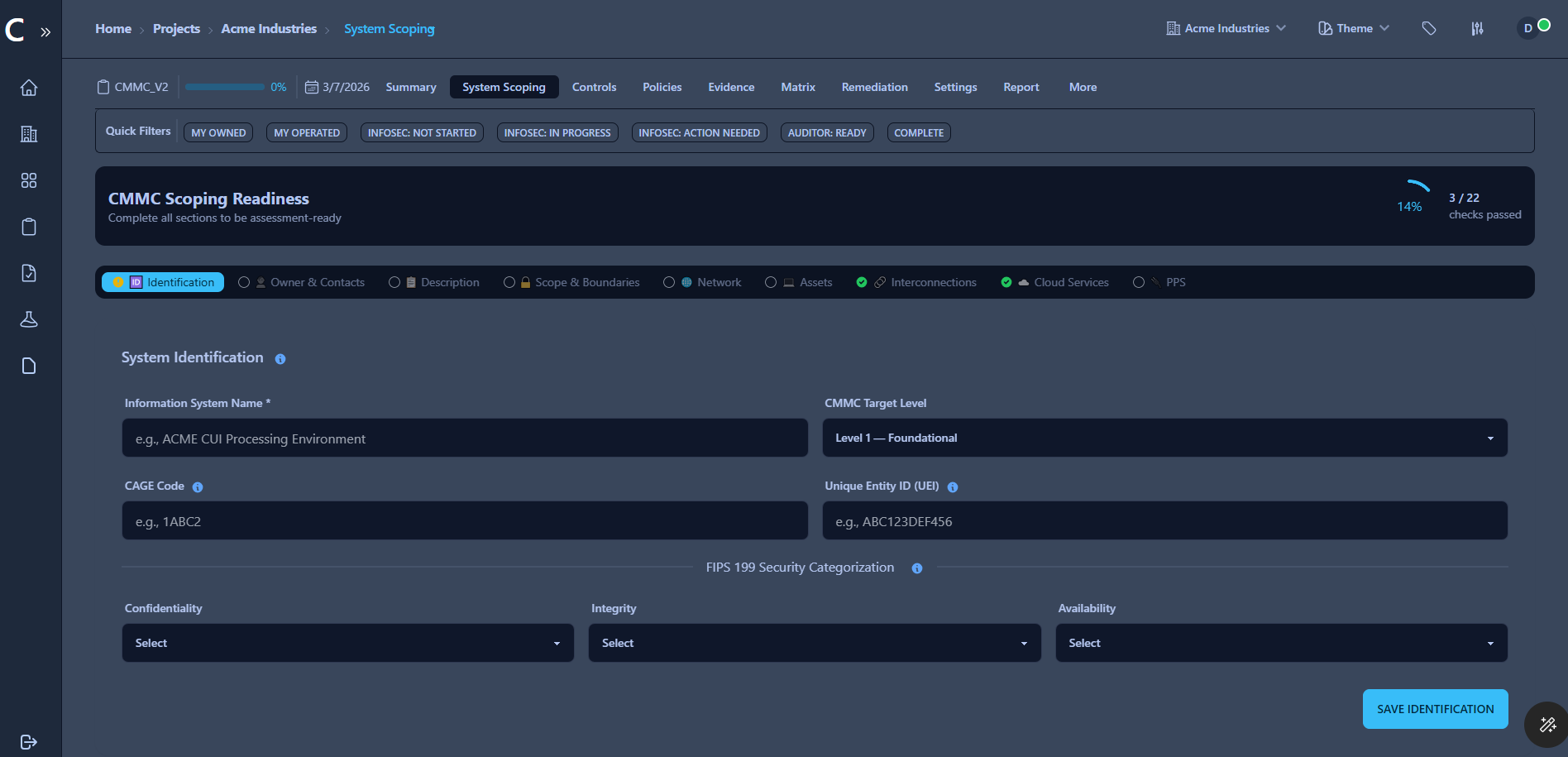
Scope definition
Record the systems, environments, and assets that define your boundary so scoping decisions are explicit and reviewable.
Practices and objectives
Work at the requirement and objective level, with status and rationale on each.
Evidence
Associate supporting artifacts with the requirements they substantiate, with owners and review state.
SSP information
Organize the system and implementation information needed to develop and maintain the plan.
POA&M tracking
Carry each deficiency through corrective action, ownership, target date, and evidence of closure.
SPRS score support
Maintain the underlying requirement status information your team uses when determining and reporting a self-assessment score.
Findings and remediation
Convert findings into prioritized, owned, dated work items.
Ongoing maintenance
Keep the program current after the initial assessment rather than rebuilding it each cycle.
Workflow
A structured path for this framework
- Scope
- Assess
- Identify Gaps
- Remediate
- Document
- Prepare
- Maintain
Modules
Capabilities most used for this framework
Assessments
Evaluate requirements and assessment objectives using consistent statuses so progress is measurable rather than anecdotal.
Read more →Evidence Management
Keep supporting documentation associated with the requirements it proves, with ownership, review status, and dates that hold up under review.
Read more →SSP & POA&M
Structure the information needed to develop and maintain a System Security Plan, and track deficiencies through a Plan of Action & Milestones.
Read more →Remediation
Move from identifying a deficiency to resolving it with priorities, owners, tasks, due dates, and evidence of closure.
Read more →Asset Management
Maintain the systems, environments, and asset records that define the boundary your compliance program applies to.
Read more →Reporting & Dashboards
See compliance posture, framework progress, open findings, remediation status, evidence state, and overdue work in one view.
Read more →FAQ
CMMC questions
Does CyberComply certify my organization for CMMC?
No. CyberComply is software that supports readiness and compliance management. Certification is issued through the formal assessment process conducted by an authorized assessment organization.
Is Armada Cyber Defense a C3PAO?
Nothing on this site should be read as a claim of C3PAO or assessor authorization. CyberComply supports the software side of managing a compliance program.
Does CyberComply support Level 1 and Level 2?
The platform organizes requirements, objectives, evidence, and remediation for the CMMC program. Which requirements apply to your organization depends on your level and scope.
Can CyberComply help with our SPRS self-assessment score?
CyberComply maintains the requirement status information your team relies on when determining and reporting a score. The determination and submission remain your organization's responsibility.
CyberComply supports readiness and compliance management. It does not certify an organization. Formal CMMC assessment and certification are performed by authorized third-party assessment organizations, which is a separate activity from the software-supported readiness work described here.
CyberComply is a software platform that assists organizations in managing governance, risk, compliance, documentation, and readiness activities. Using CyberComply does not by itself guarantee regulatory compliance, certification, authorization, or a successful assessment.
Related frameworks
Often managed alongside this one
Ready to bring your compliance program together?
See how CyberComply can help centralize requirements, evidence, risks, remediation, documentation, and assessment readiness.